


How to Learn Japanese with Anime: A Realistic Guide (2026)
Can you really learn Japanese from anime? What works, what to avoid copying, the best anime for each level, and a 20-minute daily routine on YouTube and Netflix.
8 min read
Short answer: yes, anime can teach you a lot of Japanese, especially listening and everyday vocabulary, but only if you watch actively and pair it with some grammar study. Passive binge-watching with English subtitles teaches very little. Watching with Japanese subtitles, looking up what you don’t know, replaying lines and saying them out loud does.
This guide explains what anime is good and bad at, which shows suit each level and why, and gives a routine you can follow on YouTube and Netflix.
Can you actually learn Japanese from anime?
Learners who got far with anime almost always describe the same thing: anime was the motivation and the listening practice, not the whole method. Here’s what it does well and where it falls short.
What anime is good at
- Listening at natural speed. You hear real rhythm, intonation and contractions like じゃない → じゃん, which textbooks rarely drill.
- High-frequency vocabulary in context. Words like 大丈夫, やばい, 本当に and さすが show up again and again, each time in a scene that makes the meaning memorable.
- Motivation. Hundreds of hours of input is only realistic if you enjoy it.
What anime is bad at
- Polite Japanese. Most characters are teenagers or friends talking casually. You’ll hear far more タメ口 (casual speech) than the です/ます forms you need with strangers, at work or in a shop.
- Grammar explanations. Anime shows you patterns without telling you the rules. Without a grammar reference, many sentences stay half-understood.
- Neutral speech. Characters often talk in ways no real person does, which brings us to the biggest pitfall.
The “anime Japanese” trap: role language
Japanese linguist Satoshi Kinsui coined the term 役割語 (yakuwarigo, “role language”) for speech styles that instantly signal a character type: the old professor who says わしは…じゃ, the refined young lady with …ですわ, the tough guy ending sentences with ぜ and ぞ. Anime uses role language constantly because it makes characters recognizable in seconds.
That’s great for storytelling and risky for learners who copy it. Some examples to recognize but not imitate:
| What you hear | What it signals | What to say instead |
|---|---|---|
| 俺 (ore) for “I” | Masculine, casual, can sound rough | 私 (watashi), or 僕 (boku) for casual male speech |
| …だぜ / …ぞ | Tough, masculine emphasis | …だよ, or just …だ |
| …ですわ | Stylized upper-class femininity | …です |
| …だってばよ | A single character’s catchphrase (Naruto) | Nothing. It isn’t real Japanese |
| てめえ / 貴様 | Hostile “you” | Use the person’s name + さん |
The movie Your Name (君の名は。) has a famous scene that shows how much this matters: a character in someone else’s body tries 私, then 僕, then 俺, and each choice changes how others react. Watch for these markers and you’ll learn something real about Japanese, namely that pronouns and sentence endings carry social meaning.
Particles: where anime subtitles mislead you
Particles are tiny words that carry grammar, and they’re where translation tools fail most. Look at what Google Translate does with は, the topic particle:
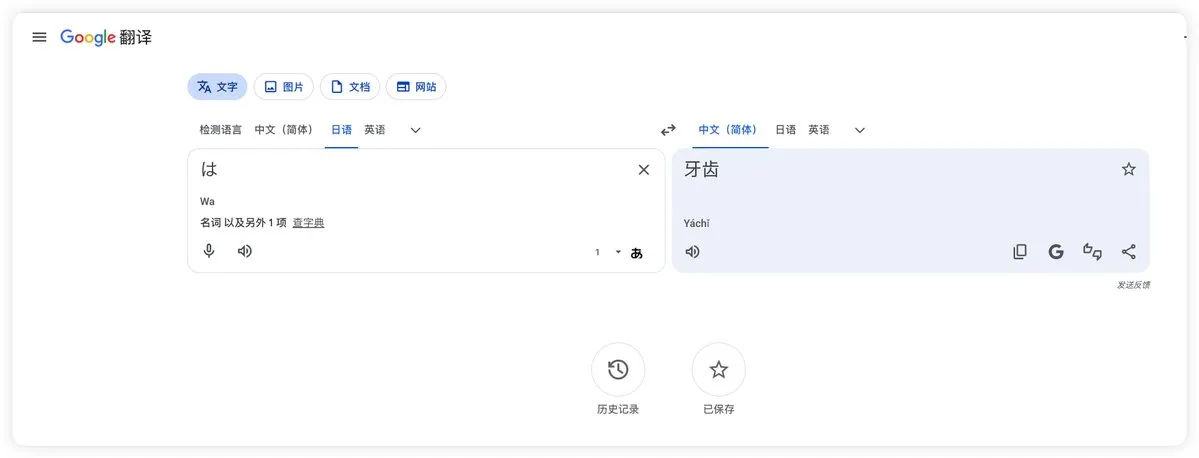
It answers “teeth”, because 歯 (tooth) is also read ha. A tool that translates words without the surrounding sentence will make this kind of mistake constantly with は, が, に, で and the rest.
The particles you’ll hear in every episode:
- は vs が. 僕は行く means “As for me, I’ll go” (は sets the topic). 僕が行く means “I’m the one who’ll go” (が points to who does it, often as new or contrasting information). Anime fights and confessions use this contrast constantly.
- よ. Adds emphasis or tells the listener something new: 行くよ! “I’m going!”
- ね. Seeks agreement or softens a statement: いい天気だね “Nice weather, isn’t it?”
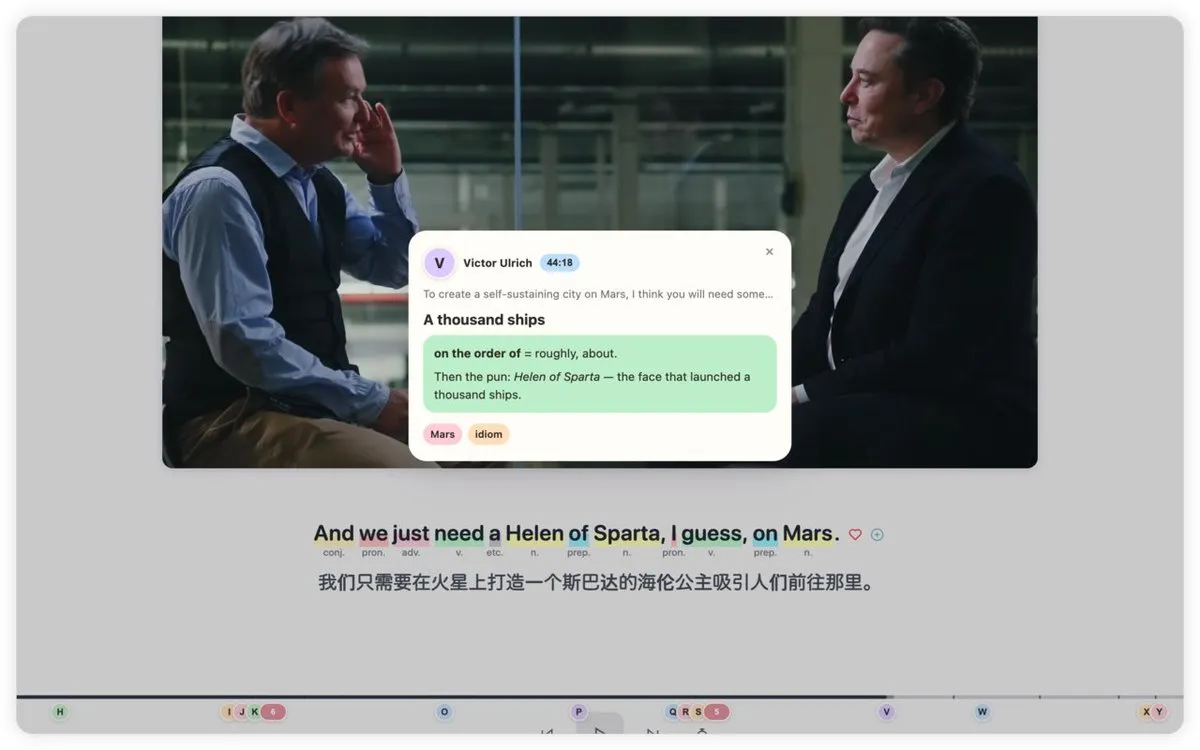
When you look up a particle, make sure your tool explains it in the context of the sentence. LingTube sends the whole subtitle line to a large language model and labels each word’s part of speech, so は shows up as a particle, not as a noun meaning “tooth”.
The best anime for learning Japanese, by level
Look for shows with everyday settings, clear speech and Japanese subtitles available in your region. Fantasy battles and period dramas are fun but full of words you won’t use. Availability differs by country, so check Netflix’s audio and subtitle menu for Japanese subtitles before you commit.
Beginner
- Chi’s Sweet Home (チーズスイートホーム). Episodes are about three minutes long, with simple narration about a kitten and a family. Short enough to replay a whole episode.
- Shirokuma Cafe (しろくまカフェ). A relaxed café comedy with lots of polite, everyday conversation and wordplay. One of the few anime where you’ll hear plenty of です/ます.
- Doraemon (ドラえもん). Family and school vocabulary, slow pacing, and stories you can follow from the pictures.
Intermediate
- Spy x Family (SPY×FAMILY). A great register lesson in one show: Loid’s polite, controlled speech, Anya’s childish grammar and Yor’s formal politeness.
- Haikyuu!! (ハイキュー!!). Natural casual speech among high school students, with sports vocabulary that’s easy to infer from the action.
- Frieren: Beyond Journey’s End (葬送のフリーレン). Calm pacing and clearly spoken dialogue. The fantasy vocabulary repeats a lot, so it becomes familiar quickly.
Advanced
- Death Note (デスノート). Dense, logical dialogue and inner monologue, plus formal and intellectual vocabulary.
- Demon Slayer (鬼滅の刃). Set in the Taishō era, with old-fashioned expressions and sword-technique names. Good for stretching your listening, not for everyday phrases.
- Crayon Shin-chan (クレヨンしんちゃん). Fast, slangy and full of wordplay that’s hard even for intermediate learners. Watch it to understand jokes, not to copy the way Shin-chan talks.
A 20-minute daily routine with anime
This routine works on YouTube (official clips and Shorts) and Netflix in a desktop browser.
- Pick one 3–5 minute scene (2 minutes). Short is the point: you’ll watch it several times.
- Watch once with Japanese and English subtitles (5 minutes). Get the gist. Don’t stop for every word.
- Go line by line (8 minutes). Replay each line, tap the words you don’t know, and check grammar you can’t parse. Turn on furigana if kanji slow you down.
- Shadow your favorite lines (3 minutes). Play a line, pause, and repeat it with the same rhythm. See the full shadowing technique guide.
- Watch once more with Japanese subtitles only (2 minutes). Notice how much more you understand than on the first pass.
If you’re new to dual subtitles, start with how to get dual subtitles on YouTube and Netflix. If a scene feels impossible, it’s too far above your level. The comprehensible input guide explains how to choose material that’s hard enough but still understandable.
How LingTube helps with anime
LingTube was built for exactly this kind of line-by-line watching on YouTube and Netflix:
- Dual subtitles (free) with Japanese on top and your language below, on regular videos and on YouTube Shorts, where many official anime clips live.
- Word and phrase translation that uses the whole sentence. Tap a word or drag across a phrase. The meaning is chosen from the full sentence, which matters for particles and casual contractions.
- Furigana and part-of-speech tags. Kanji readings above the text, and every word labeled as a noun, verb, particle, and so on.
- Grammar analysis. One click breaks down the current line and pulls out set phrases and slang.
- Free shadowing. Record yourself repeating a line and compare your waveform with the original.
- Danmaku. Live on-screen comments from other learners watching the same video.
Save what you learn with timestamped notes
When a line teaches you something, such as a new particle use or a phrase you’ll want later, pin a note to that exact moment. Notes support Markdown, can be private or public, and one click takes you back to the clip when you review.
Word saving, grammar analysis, furigana, part-of-speech tags and notes are part of LingTube’s paid plans. Every new account gets 3 days of Premium to try them, and dual subtitles, danmaku and shadowing stay free.
FAQ
Can you become fluent in Japanese just by watching anime?
Very unlikely on its own. Anime builds listening and vocabulary, but you’ll also need grammar study, reading practice and speaking practice. Many learners use anime as their main source of input alongside a grammar guide and flashcards.
Should I watch anime with English or Japanese subtitles?
Use Japanese subtitles, or Japanese and English together (dual subtitles), as soon as you can read kana. English-only subtitles let you follow the story without processing much Japanese. As you improve, drop the English line.
What’s the easiest anime to learn Japanese from?
Slice-of-life shows with simple, everyday dialogue, such as Chi’s Sweet Home, Shirokuma Cafe or Doraemon. Avoid starting with fantasy or historical settings, which use a lot of specialized vocabulary.
Is anime Japanese “wrong”?
It’s real Japanese, but often exaggerated or stylized. Pronouns like 俺, rough sentence endings, and character catchphrases are fine to understand and risky to copy. If in doubt, follow how the polite adult characters speak.
Where can I watch anime with Japanese subtitles?
Netflix offers Japanese subtitles for many anime, depending on your region. Check the audio and subtitle menu of each title. On YouTube, many studios post official clips and episodes, and LingTube can transcribe videos that have no subtitles.