


Comprehensible Input: What It Is and How to Use It with YouTube
Comprehensible input explained for self-learners: Krashen's i+1, what research says about how much you need to understand, and how to turn any YouTube video into CI.
7 min read
Comprehensible input (CI) is language you hear or read that you mostly understand, with a small amount that’s new to you. The idea, popularized by linguist Stephen Krashen, is that we acquire a language by understanding messages in it, not by memorizing rules. For self-learners, the practical question is less “is CI true?” and more “how do I find enough input that I actually understand?” This guide answers both.
What is comprehensible input?
Krashen set out the Input Hypothesis in the late 1970s and early 1980s, most famously in Principles and Practice in Second Language Acquisition (1982). Its core claim is that we acquire language when we understand input that is slightly beyond our current level, which he wrote as i+1: i is what you already know, and +1 is the next step.
It is one of five connected hypotheses:
| Hypothesis | The claim, in plain words |
|---|---|
| Acquisition vs. learning | Picking up a language through meaning (acquisition) is different from studying rules (learning). |
| Monitor | Rules you studied mainly act as an editor that checks your output when you have time to think. |
| Natural order | Grammar structures are acquired in a fairly predictable order, regardless of teaching order. |
| Input | Acquisition happens when you understand messages slightly above your level (i+1). |
| Affective filter | Anxiety and low motivation block input from being absorbed. |
Comprehensible input examples
- A beginner watching a cooking video in Spanish, where the actions make words like cortar (cut) and añadir (add) obvious.
- An intermediate learner reading a graded reader with one or two unknown words per page.
- A teacher using gestures, pictures and simple sentences to tell a story in the target language.
- You re-watching a scene from a show you’ve already seen in your native language, this time with the target-language audio.
What these have in common: context does most of the work, and the new words are few enough that you can work them out.
What the research says (and where CI is debated)
CI is influential but not uncontested, and it helps to know both sides.
The evidence for it. Countless studies show that large amounts of understood input build vocabulary and listening skills, and extensive reading and listening programs reliably help learners.
The criticisms. Researchers have pointed out that “i+1” is hard to define or measure, which makes the hypothesis difficult to test directly. Merrill Swain’s Output Hypothesis (1985) argued that input alone isn’t enough: having to speak and write makes learners notice gaps in their grammar. Most researchers today see input as essential but not sufficient on its own.
The most useful number: how much you need to understand. Studies of lexical coverage, the share of words in a text you already know, give practical targets:
- For reading, Hu and Nation (2000) found that adequate unassisted comprehension of fiction needs about 98% coverage, or roughly one unknown word in 50.
- For listening, van Zeeland and Schmitt (2013) found that 95% coverage was enough for most listeners to understand well. That’s about one unknown word in 20.
- Webb and Rodgers (2009) estimated that knowing the most frequent 3,000 word families (plus proper nouns) gives about 95% coverage of movies and TV, while 98% takes 6,000–7,000.
In other words, “comprehensible” means most words are known. If you’re looking up every third word, the video isn’t comprehensible input yet. It’s a puzzle.
How to turn any YouTube video into comprehensible input
Most native content is above a learner’s level at first. Instead of waiting until you’re “ready”, you can make content more comprehensible. Each technique below either adds context or reduces the number of unknowns.
1. Know what the video is about before you watch
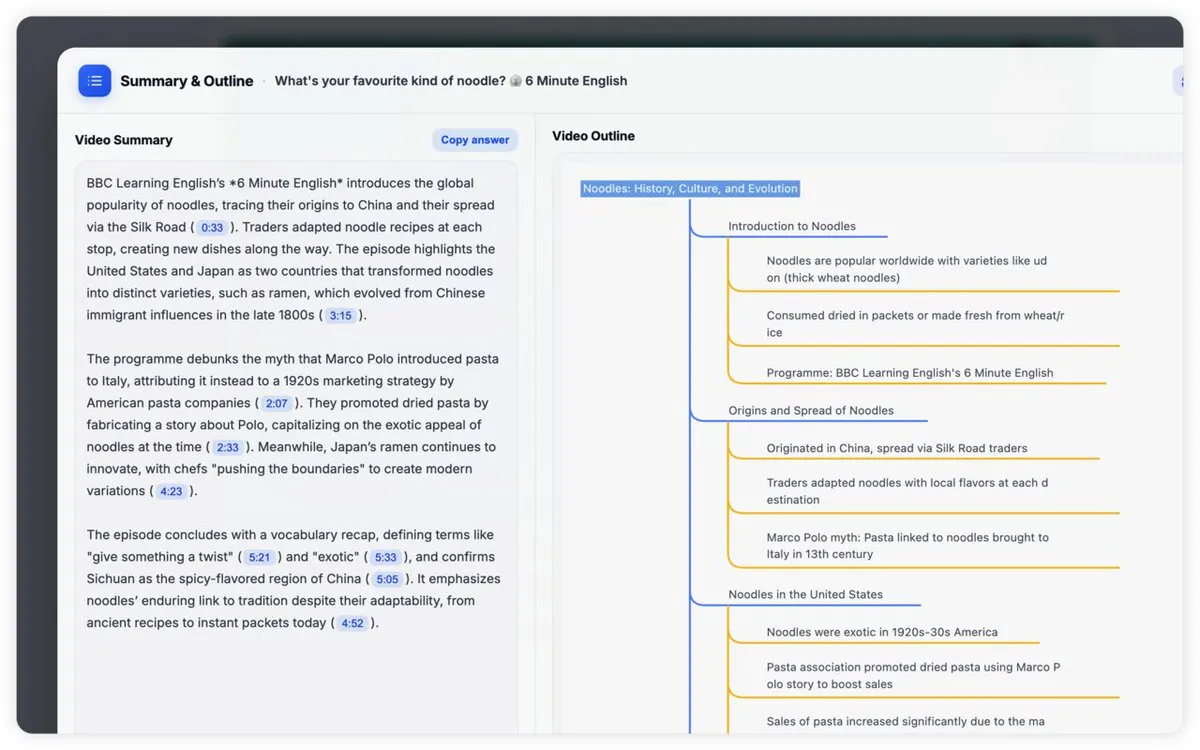
Context is the biggest comprehension booster. Read the title, the description and the chapter names first. On YouTube, LingTube can generate a summary and outline with clickable timestamps, so you know the storyline before the first sentence:
2. Use dual subtitles as scaffolding, not a crutch
Showing the target language with your native language underneath turns many unknown words into known ones instantly. The skill is to read the target line first and only check the translation for the gaps. See how to get dual subtitles on YouTube and Netflix for setup.
3. Resolve unknown words in context
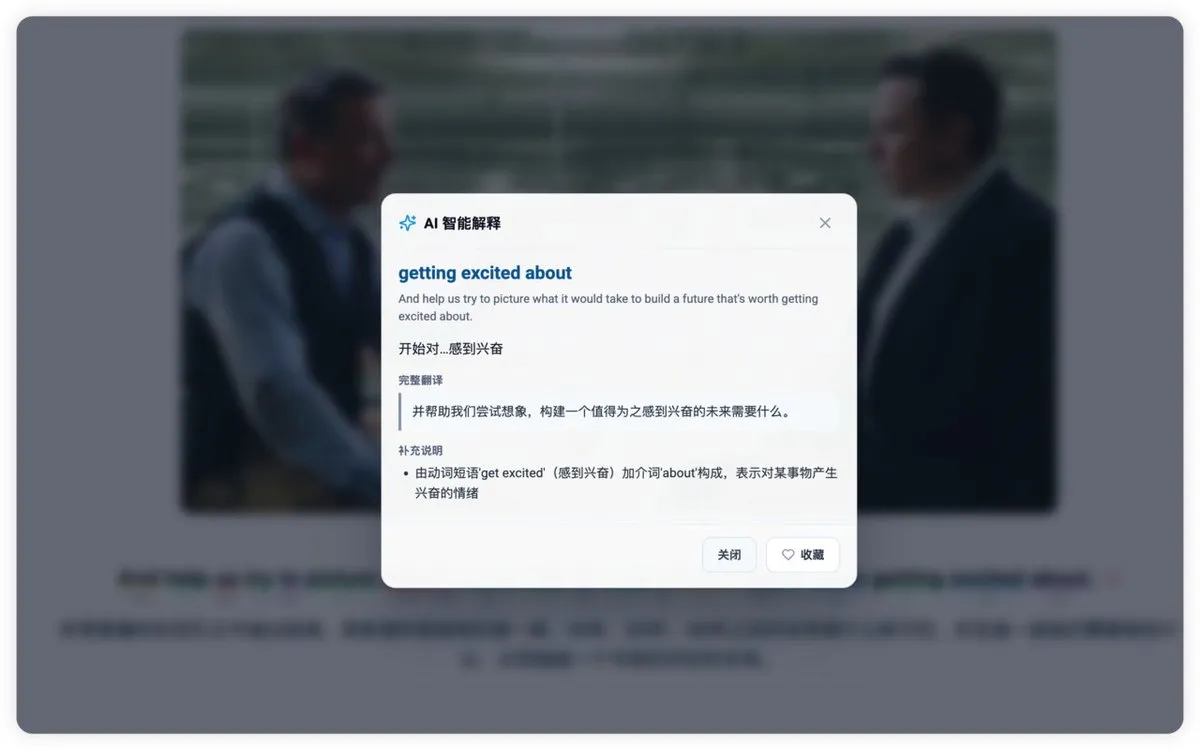
A dictionary gives you every meaning. What you need is the meaning in this sentence. Select the word or the whole phrase and get an explanation based on the full line:
4. Fix broken subtitles before they confuse you
YouTube’s auto-generated subtitles are split by timing, not by meaning, so you often read half a sentence at a time. Merging fragments back into full sentences, or re-transcribing the audio with AI when the subtitles are poor, removes a lot of confusion that has nothing to do with your language level.
5. Replay instead of pushing on
One sentence understood after three replays is worth more than five minutes of noise. Loop the line, then move on.
6. Pick content near your level
Use the 95% rule as a gut check: if you understand most of a one-minute sample with subtitles, the video is a good fit. LingTube labels words with CEFR levels (A1–C2), which makes it easier to see whether a video is mostly A2 vocabulary or full of C1 words.
A CI plan by level
| Level | Good input | How to make it comprehensible |
|---|---|---|
| Beginner (A1–A2) | Videos for learners, “comprehensible input” channels, short vlogs, kids’ shows | Dual subtitles always on; replay often; choose visual content |
| Intermediate (B1–B2) | Vlogs, interviews, YouTube explainers, sitcoms, anime | Read the summary first; target-language subtitles with translation only on demand |
| Advanced (C1+) | Podcasts, documentaries, news, films | Target-language subtitles only, then no subtitles; look up only key words |
Whatever your level, add some output. Repeating lines out loud with the shadowing technique is an easy way to start speaking without a partner. If you’re learning Japanese, the guide to learning Japanese with anime shows how to apply CI to shows you already love.
Comprehensible input for Japanese, Spanish, French and more
CI works for any language, but each has its own hurdle:
- Japanese: the writing system. Use furigana (kanji readings) so reading doesn’t block understanding, and learn kana before relying on subtitles.
- Korean: speech levels and fast, connected pronunciation. Variety shows with heavy on-screen text are surprisingly good input.
- Spanish: speaking speed and regional variety. Pick one accent to start, such as Mexican or Peninsular Spanish, and widen later.
- French: the gap between spelling and sound. Subtitles help you map what you hear to what’s written.
- German: long compound words and verbs at the end of the sentence. Sentence-level translation helps more than word-by-word lookup.
- English: the sheer amount of content. The challenge is choosing, so filter by level and interest.
LingTube supports all of these as learning languages, plus Italian and Simplified Chinese.
FAQ
What is comprehensible input in simple terms?
Language you mostly understand, with a few new words or structures you can figure out from context. According to Krashen, understanding such input is how languages are acquired.
What does i+1 mean?
i is your current level and +1 is the next step just beyond it. Input at i+1 is challenging enough to teach you something but easy enough to understand.
Is comprehensible input enough to become fluent?
Most researchers think input is necessary but not sufficient. Speaking and writing help you notice gaps and build fluency, so combine lots of input with some output practice.
How many hours of comprehensible input do I need?
There’s no scientifically fixed number, and it depends heavily on the language and how close it is to languages you already know. What research does show is that vocabulary size, and therefore comprehension, grows with the amount of input, so regular daily input matters more than any single target.
Can YouTube be comprehensible input?
Yes, if the video is close to your level or you add support: context first, dual subtitles, word lookup in context, and replaying lines. Without that support, most native videos are too hard for beginners.