


Best Korean Subtitles Extensions for Chrome: Learn Korean on YouTube and Netflix (2026)
A comprehensive guide to Korean dual subtitle extensions for Chrome: master 은/는 vs 이/가 particles, navigate speech levels and honorifics, and build an effective 20-minute K-drama study routine.
4 min read
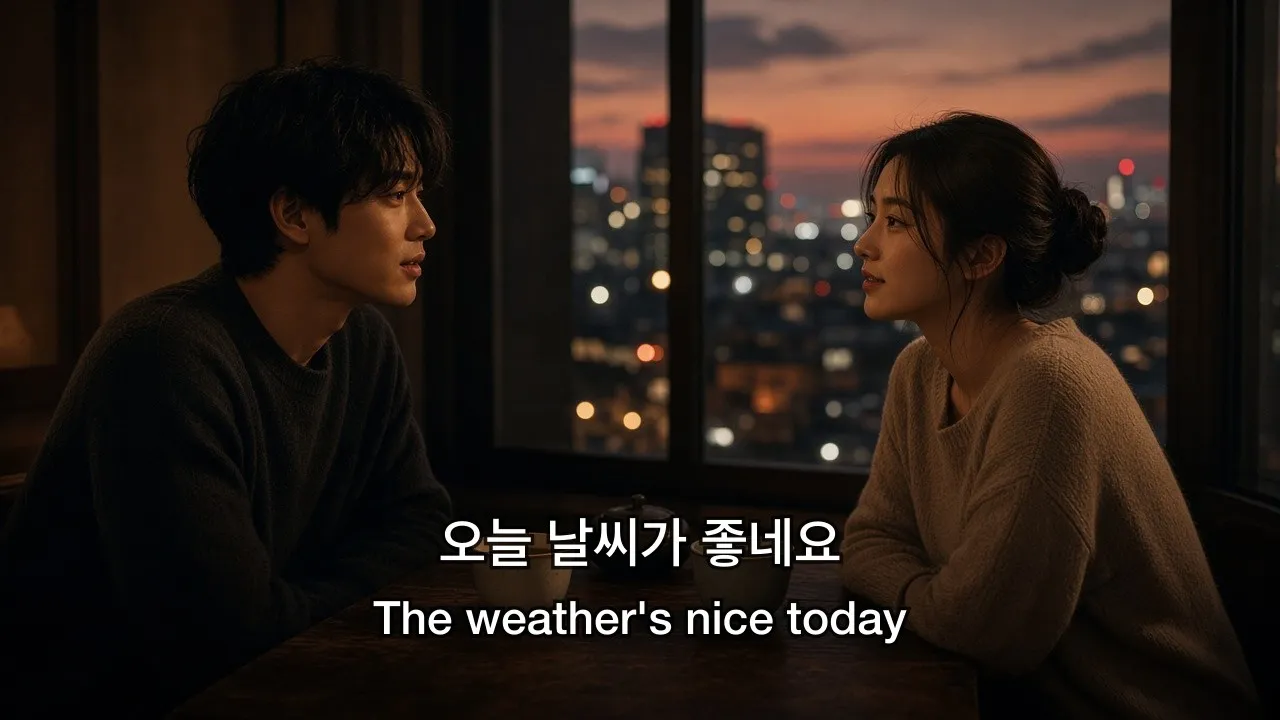
Short answer: A Korean subtitles extension overlays a synchronized second subtitle track inside the YouTube and Netflix players on desktop Chrome, allowing learners to read authentic Hangul dialogue alongside native-language translations. In this category, LingTube stands out as an extension engineered specifically for rigorous language acquisition. Moving from passive entertainment to genuine comprehension requires understanding the underlying grammatical architecture of what you just heard: which particle was selected, which honorific speech level was used, and why.
Disclosure: This guide is written by the LingTube team. All feature comparisons and competitor details were verified against official product platforms as of October 2026.
What a Korean Subtitles Extension Actually Does
Default YouTube and Netflix players only permit one active subtitle track at a time. A dual subtitles extension renders two lines simultaneously: typically Hangul on top for reading practice and your native language underneath for immediate reference. Beginners can easily swap their positions or temporarily hide the translation track to train listening comprehension.
In this ecosystem, Language Reactor is an established veteran supporting YouTube and Netflix; Trancy covers additional streaming services with mobile support; and LingTube focuses deeply on YouTube (including Shorts) and Netflix, delivering context-aware LLM translations, precise part-of-speech tagging, and instant sentence analysis exclusively on desktop Chrome.
On Netflix, LingTube reads Netflix’s authentic native Korean subtitles and official translation tracks. If a particular title lacks a translation in your language, the extension never substitutes inaccurate machine translations as “official” subtitles. If certain available languages are hidden, adjusting your Netflix profile language resolves the issue (see how to get dual subtitles on YouTube and Netflix).
LingTube’s core dual subtitles, single-click word lookups, and shadowing features are completely free. Deep grammar analysis, AI audio transcription, and timestamped notes are available on paid plans (Plus $5.99/mo, Premium $9.99/mo), with a 3-day free Premium trial for all new users.
Why Relying on Translations Alone Won’t Teach You Korean
Korean is an agglutinative language whose nuanced meaning is anchored almost entirely in particles and verb endings. Standard subtitle translations prioritize smooth English phrasing, invariably wiping out these vital structural clues.
1. The Critical Difference Between 은/는 (Topic) and 이/가 (Subject)
Beginners frequently confuse these two foundational particle pairs. Notice how two common K-drama lines differ:
- 저는 학생이에요. (“As for me, I’m a student.”) — Here, 는 serves as the topic marker. It establishes the conversational frame: “Speaking about myself, my role is a student.”
- 제가 학생이에요. (“I am the student / It’s me who is the student.”) — Here, 가 functions as the subject marker, used when identifying new information or emphasizing who is performing the action (for instance, answering the question “Who among you is the student?”).
A basic dictionary defining 저 simply as “I / me” cannot clarify this essential distinction. Only by analyzing the complete subtitle line can you grasp how particles steer the sentence. LingTube’s morphological parser identifies every Korean morpheme, highlighting stems and particles with crystal clarity.
2. Social Dynamics Encoded in Speech Levels
Korean verb endings reflect social hierarchy, familiarity, and situational formality:
| Spoken Line | Speech Level | Common Context |
|---|---|---|
| 밥 먹었어? | Banmal (Casual informal) | Close friends of the same age, or addressing children |
| 밥 먹었어요? | Haeyo-che (Polite informal) | Standard polite adult conversation in daily life |
| 식사하셨어요? | Honorific polite style (Haeyo-che + -시-) | Addressing elders, superiors, or formal business clients |
Using casual banmal when dining with an elder or a colleague’s parents is a major social blunder. Yet English subtitles will translate all three simply as “Have you eaten?”. Observing original endings on subtitle tracks is the only way to internalize culturally appropriate Korean.
A High-Yield 20-Minute K-Drama Study Routine
Select a 3 to 5-minute dialogue scene from a modern contemporary drama (workplace or slice-of-life dramas offer far more practical vocabulary than historical sageuk epics):
- Active Listening (8 minutes): Play the scene with Korean audio and Hangul subtitles only. Rely entirely on the original audio. Unhide the translation track only for lines you cannot mentally parse. Use subtitle masking to conceal text until you are ready to check your comprehension.
- Grammar Breakdown (4 minutes): When you encounter an unfamiliar verb conjugation or tricky connective particle, click for instant AI grammar analysis and save the construction to your review deck.
- Learn Cultural Nuance via Danmaku (3 minutes): Enable the danmaku overlay. Enthusiastic viewers frequently flag wordplay, cultural references, double entendres, and internet memes directly on the timeline (danmaku is completely free).
- Capture Timestamped Notes (2 minutes): Pause at compelling lines and log a Timestamped Note. Clicking the note later jumps the player straight back to that exact second of dialogue.
- Shadowing Practice (3 minutes): Pick 2 or 3 authentic lines and practice Shadowing, speaking slightly behind the actor to lock in natural intonation, cadence, and muscle memory.
If a drama feels overwhelmingly incomprehensible, it is beyond your current level. Follow the principles of Comprehensible Input and step back to accessible vlogs or animated shows where you already recognize 80%+ of the vocabulary.
When Videos Lack Quality Captions: Turn to YouTube
On YouTube, many Korean vlogs and interviews feature auto-generated captions split erratically across pauses. LingTube’s Smart Sentence Merging automatically stitches these fragments back into coherent sentences. If a video completely lacks captions, AI Audio Transcription can generate high-accuracy Korean subtitles directly from the audio stream.
Note that AI transcription and summarization are exclusive to YouTube; on Netflix, you continue to enjoy official dual subtitles, live grammar analysis, danmaku comments, timestamped notes, and shadowing.